Zentec Motor Zentec Motor

How to Choose the Right Linear Motor in 2026

Time:2026-11-08 Author:Ethan
0%

Choosing a Linear Motor in 2026 is not simply a matter of buying the fastest axis. The right choice depends on the load, travel distance, duty cycle, accuracy, and operating environment. A motor that moves a lightweight inspection camera smoothly may struggle with a heavy gantry running three shifts a day. Small details matter.

Linear-motor pioneer Eric Laithwaite is associated with a useful description: “A linear motor is a rotary motor laid flat.” That idea explains the direct drive, but not the full selection process. There is no gearbox to hide sizing mistakes. Engineers must check peak and continuous force, acceleration, heat dissipation, cable movement, and encoder resolution. A stainless-steel production line may also need different protection from a clean, temperature-controlled laboratory.

This guide compares key motor types and turns application needs into practical selection criteria. It covers force and speed calculations, precision, cooling, controls, installation, and total system cost. It also explains where ironless designs can reduce cogging, and where iron-core motors may offer higher force density. Real specifications deserve scrutiny. Catalog numbers alone can be misleading, especially when peak force is mistaken for continuous force. Measure the actual load, define the motion profile, and leave room for uncertainty. The best Linear Motor is the one that meets the required performance reliably, without paying for capabilities the machine will never use.
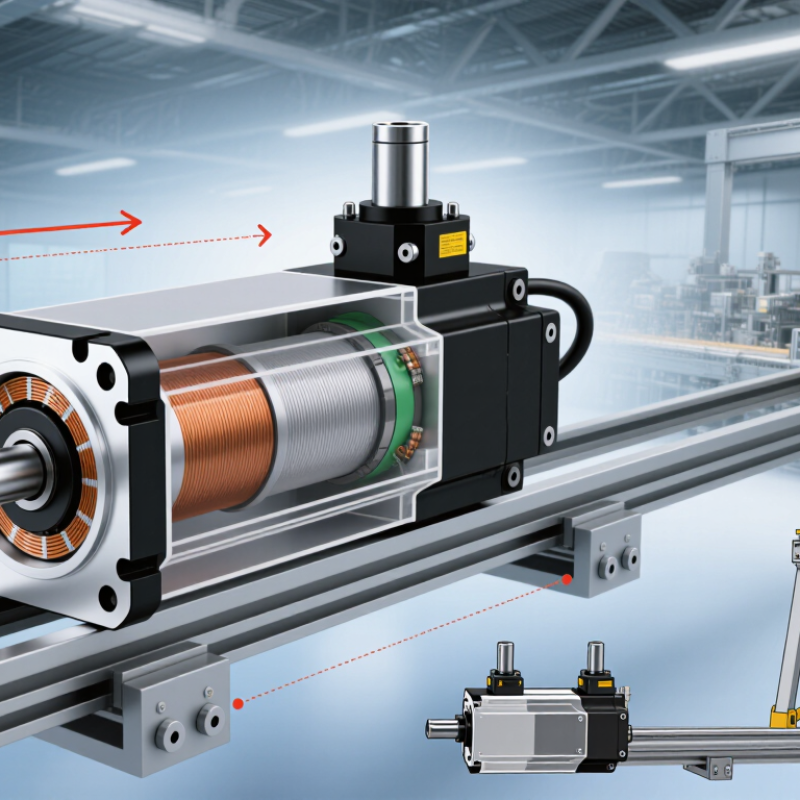
How to Choose the Right Linear Motor in 2026

Define the Motion Requirements and Operating Conditions

Start with the motion profile, not the motor catalog. Record the moving mass, stroke, peak speed, acceleration, and required settling time. Separate peak thrust from continuous thrust; a motor may handle a brief acceleration but overheat during repeated cycles. Add friction, cable drag, and any external force. Then calculate the duty cycle from actual move, dwell, and return times.

Operating conditions change the answer. Note ambient temperature, available cooling, dust, vibration, mounting orientation, and how often the axis runs. A machine beside a warm enclosure may need more thermal margin than the same axis in a cool lab. IFR’s World Robotics 2024 report counted 541,302 industrial robot installations worldwide in 2023, a reminder that motion axes increasingly operate within tightly integrated, automated systems. That figure is context, not a sizing rule.

Specify the positioning target across the full stroke, not just at one point. ISO 230-2 provides a framework for testing axis positioning accuracy and repeatability at multiple positions. Check whether the process needs high absolute accuracy, repeatable return, or both; they are not interchangeable. I’d also leave room for the part nobody measured—the cable carrier can add drag, and the real payload may vary. A little awkward, perhaps. Better to revisit the assumptions before choosing a motor.

How to Choose the Right Linear Motor in 2026: Define Motion Requirements and Operating Conditions

Example motion profile for a horizontal axis: 600 mm travel, 1.5 m/s peak speed, and 5 m/s² acceleration and deceleration. These are illustrative design inputs, not product specifications.

Use the required travel, speed, acceleration, payload, orientation, and cycle rate to define the application before comparing motors. Verify thrust and thermal capacity for the actual load, friction, duty cycle, and operating environment.

Compare Linear Motor Types and Their Operating Principles

How to Choose the Right Linear Motor in 2026

Compare Linear Motor Types and Their Operating Principles

Linear motors create motion directly along a straight path, instead of converting rotary motion through screws or belts. Their operating principles differ.

A linear induction motor uses a traveling magnetic field to induce current in a conductive track, producing thrust without permanent magnets. It can suit robust transport tasks, though heat and efficiency need attention.

A permanent-magnet synchronous motor uses magnets on the moving part and controlled currents in stationary coils. The magnetic fields work together to generate precise thrust. Iron-core designs can deliver high force in a compact space, but magnetic attraction may increase friction-like effects called cogging. Ironless designs reduce cogging and moving mass, which helps with delicate positioning. They may require more space or a different cooling strategy.

Small details matter.

For a real selection, compare peak and continuous force, travel distance, speed, duty cycle, and feedback requirements. A carriage that moves a few kilograms slowly has different needs from one making rapid, repeated strokes. Check the motor’s thermal limits and the rigidity of its mounting surface; even a capable motor performs poorly on a flexible frame. Test the actual payload if possible. Specifications help, but they do not capture every cable bend, alignment error, or vibration.

I would not choose by force rating alone.

Calculate Force, Speed, Stroke, and Precision Requirements

How to Choose the Right Linear Motor in 2026

Start with the load, not the motor catalog. Calculate force from moving mass multiplied by acceleration, then add measured friction and process force. A 12-kilogram carriage accelerating at 3 m/s² needs 36 newtons before those extra loads. Check peak force during acceleration and continuous force across the full duty cycle. A motor that handles a brief peak may still overheat during repeated moves.

Set speed and stroke from the actual motion profile, including settling time and pauses. Then define precision carefully: resolution, repeatability, and absolute accuracy are different specifications. ISO 230-2 describes methods for testing positioning accuracy and repeatability; use measured results, not resolution claims alone. Energy matters too: the International Energy Agency reports that electric motor-driven systems use about 45% of global electricity. Efficient sizing is practical, not just neat on paper. Still, calculations can miss real friction. Test the mechanism under its working load.

Tips: Record payload, acceleration, travel distance, and cycle rate. Add a sensible force margin, then validate temperature and positioning on the machine. Don’t guess the margin.

Evaluate Controls, Thermal Limits, and System Integration

How to Choose the Right Linear Motor in 2026

Evaluate Controls, Thermal Limits, and System Integration

A linear motor is only as useful as its controls. Check whether the drive can handle the required encoder feedback, motion profile, and communication cycle. For a fast pick-and-place axis, even small delays can cause overshoot or uneven settling. Ask for measured settling time under the actual payload, not just a best-case specification. Test it with your controller.

Thermal limits need equal attention. Continuous force, short acceleration bursts, ambient temperature, and cooling all affect coil temperature. A motor may meet peak-force needs but struggle during repeated cycles. Review the duty cycle and temperature data together. Then compare them with the machine’s real operating pattern. A spreadsheet can help, but it cannot replace a warm-up test. Some plans miss this.

Integration details often decide whether installation goes smoothly. Check cable bend radius, mounting flatness, encoder alignment, and space for cooling hardware. Confirm how the motor behaves after a power interruption, and who handles tuning across the drive and controller. These questions can feel fussy. They are not. I would also leave time for one imperfect prototype run; vibration, heat buildup, or cable routing may expose assumptions that looked fine in CAD.

How to Choose the Right Linear Motor in 2026 - Evaluate Controls, Thermal Limits, and System Integration
Motor Type Typical Motion Characteristics Control and Feedback Thermal Considerations System Integration Often a Good Fit For Key Selection Checks
Iron-core linear synchronous motor High force capability in a relatively compact motor. Magnetic attraction and cogging can affect bearing loads and smooth motion. Typically uses a three-phase servo drive with commutation synchronized to position feedback. Confirm encoder resolution and commutation method. Winding temperature limits continuous force. Check whether natural cooling is sufficient or a cooling plate or liquid cooling is required for the duty cycle. Requires careful management of magnetic attraction, air gap, mounting stiffness, cable routing, and access for maintenance. High-throughput axes, heavier payloads, and applications where force density matters. Compare continuous force at the actual cooling condition, peak-force duration, attraction force, and the load capacity of guides and structure.
Ironless linear synchronous motor Low cogging and negligible normal magnetic attraction between the motor elements, supporting smooth, precise motion. Force density is generally lower than an iron-core design of comparable size. Usually requires a compatible servo drive and position feedback for closed-loop positioning and commutation. Continuous force depends on winding temperature, ambient conditions, and the thermal path into the mounting structure. Check duty-cycle limits rather than sizing from peak force alone. Magnetic attraction is reduced, but the air gap, alignment, moving cable loop, and support stiffness still need to be designed carefully. Precision scanning, inspection, and applications sensitive to cogging or magnetic forces on nearby components. Verify achievable acceleration with the payload, continuous force under real cooling conditions, feedback compatibility, and required travel length.
Linear induction motor Produces thrust through an induced current in a conductive secondary. Performance depends on operating speed and slip; positioning accuracy is determined largely by the feedback and control system. Often controlled by a variable-frequency drive or vector-control drive. Positioning applications generally need an external position sensor and suitable closed-loop control. The motor winding and conductive secondary can both generate heat. Assess thermal limits at the actual speed, thrust, duty cycle, and cooling conditions. Can suit long travel or contactless propulsion, but air-gap consistency, secondary alignment, and drive tuning affect performance. Conveyance, long-stroke movement, and applications where contactless thrust is useful and high positioning precision is not the primary requirement. Check thrust across the operating-speed range, secondary heating, sensor requirements, efficiency, and the effect of air-gap variation.
Tubular linear synchronous motor Generates direct linear motion along a cylindrical axis. Available force, stroke, and moving mass vary substantially with the motor’s design and size. Typically uses a servo drive with suitable commutation and feedback. Determine whether the selected assembly includes an encoder or requires a separate sensor. Continuous thrust is constrained by winding temperature and heat dissipation through the motor body or mounting. Review peak-force duration and thermal recovery time. Compact axial packaging can simplify the mechanism, but stroke, rod support, end stops, cable management, and contamination protection need consideration. Compact push-pull axes, pick-and-place mechanisms, and applications needing direct axial actuation. Confirm usable stroke, side-load limits, feedback options, mounting arrangement, and continuous thrust at the intended duty cycle.
Selection note: These are general architecture-level comparisons, not guaranteed ratings. Size the motor using the application’s force, speed, acceleration, payload, travel, duty cycle, ambient temperature, cooling method, and required positioning accuracy. Verify final limits and drive compatibility against the selected motor and control-system specifications.

Verify Reliability, Lifecycle Costs, and Supplier Support

A linear motor’s reliability should be judged under your actual operating conditions, not from a headline specification. Ask for repeatability, thermal, and duty-cycle data at the load and speed you expect. A motor that performs well during a short test may behave differently after hours of continuous motion. Check how the system handles dust, vibration, and heat near the machine. Small details matter.

Lifecycle cost includes more than the purchase price. Estimate energy use, installation time, commissioning, scheduled maintenance, and the cost of unplanned downtime. Ask which components may need replacement and whether spare parts will remain available. Compare written assumptions, not just quoted totals. Your own estimates may be imperfect, too; record them and revisit them after installation.

Supplier support can make a technically sound choice practical. Confirm who will help with sizing, tuning, and fault diagnosis, and ask about response times and service hours. Request clear manuals, wiring diagrams, and documented software revisions. A useful test is to describe a real fault, such as excess motor temperature during a long shift, and see whether the supplier offers a specific diagnostic path. Vague promises are hard to measure. A short support trial may reveal gaps before they become production problems.

FAQS

What information should I gather before choosing a linear motor?

Record moving mass, stroke, peak speed, acceleration, and settling time. Include friction, cable drag, and external forces. Small details count.

How do peak thrust and continuous thrust differ?

Peak thrust supports brief acceleration. Continuous thrust must suit repeated operation without overheating. Compare both with the actual duty cycle.

Which operating conditions can affect motor selection?

Note ambient heat, cooling, dust, vibration, mounting direction, and daily operating hours. A warm enclosure can change the thermal margin.

How should I define positioning performance?

Set targets across the full stroke. Decide whether you need absolute accuracy, repeatable returns, or both. They are not interchangeable.

What should I check in the drive and control system?

Confirm encoder support, motion-profile handling, and communication timing. Ask for settling-time measurements with your real payload. Test it.

How can I assess thermal performance?

Review coil-temperature data alongside continuous force, acceleration bursts, cooling, and cycle timing. A spreadsheet helps, but a warm-up test is better.

Which installation details are easy to overlook?

Check cable bend radius, mounting flatness, encoder alignment, and cooling space. A prototype may reveal vibration or awkward cable routing.

How should I compare reliability and lifecycle costs?

Request repeatability and duty-cycle data under expected loads. Estimate energy, installation, maintenance, spare parts, and downtime. My estimates may be wrong; revisit them after installation.

What support should I expect?

Confirm who handles sizing, tuning, and fault diagnosis. Ask for manuals and wiring diagrams. Try describing a motor that overheats during a long shift. Specific answers matter.

Conclusion

Choosing the right Linear Motor in 2026 starts with a clear understanding of the motion task and its operating environment. Define the required movement, duty cycle, load, installation space, and exposure to heat, dust, or vibration. Then compare motor types by how they generate motion and consider which operating principle best suits the application. Calculate force, speed, stroke length, and positioning accuracy using realistic operating conditions, allowing for acceleration, friction, and changes in load.

A suitable motor must also work reliably with its drive, feedback devices, and control system. Check thermal limits during continuous operation, confirm that the full system can be integrated into the available space, and assess how maintenance may affect uptime. Finally, compare expected service life and total lifecycle costs rather than focusing only on initial price. Supplier expertise, technical documentation, spare-part availability, and responsive support can also help ensure the chosen solution performs consistently over time.

Ethan

Ethan

Ethan is a seasoned marketing professional with a deep expertise in our company's innovative product line. With a passion for sharing knowledge and insights, he takes the lead in regularly updating our corporate blog, where he explores industry trends, product features, and effective marketing......