Zentec Motor Zentec Motor

Why Choose a Permanent Magnet Motor for Global Sourcing?

Time:2026-10-05 Author:Amelia
0%

Choosing a Permanent Magnet Motor for global sourcing involves more than comparing catalog prices. Buyers must examine efficiency, operating conditions, supplier capability, and long-term service support. A motor may look attractive on paper, yet perform poorly in a dusty factory or unstable power environment. Real purchasing decisions need evidence.

Look beyond rated output and peak efficiency. Request performance curves, temperature-rise data, insulation classes, and protection ratings. Check whether the design suits pumps, conveyors, compressors, or precision equipment. Ask for sample testing before approving a large order. Factory audits can reveal winding quality, rotor balancing practices, inspection equipment, and production discipline. These details matter.

Supplier reliability also affects total cost. Evaluate lead times, spare-part availability, warranty terms, packaging, and technical communication. Confirm applicable certifications for the destination market through qualified testing bodies. A documented quality system, such as ISO 9001, can support confidence, but it cannot replace product verification. No supplier is flawless. A spreadsheet can still miss field conditions.

Experienced sourcing teams often compare energy consumption over several years, not only the purchase price. They calculate installation costs, maintenance intervals, control compatibility, and expected duty cycles. This approach helps identify genuine value. It also exposes weak assumptions early. A careful buyer should remain willing to revise specifications after testing. That small step may prevent expensive replacements, delayed shipments, and dissatisfied customers. A Permanent Magnet Motor can be a strong global sourcing choice, but only when technical proof supports the commercial promise.
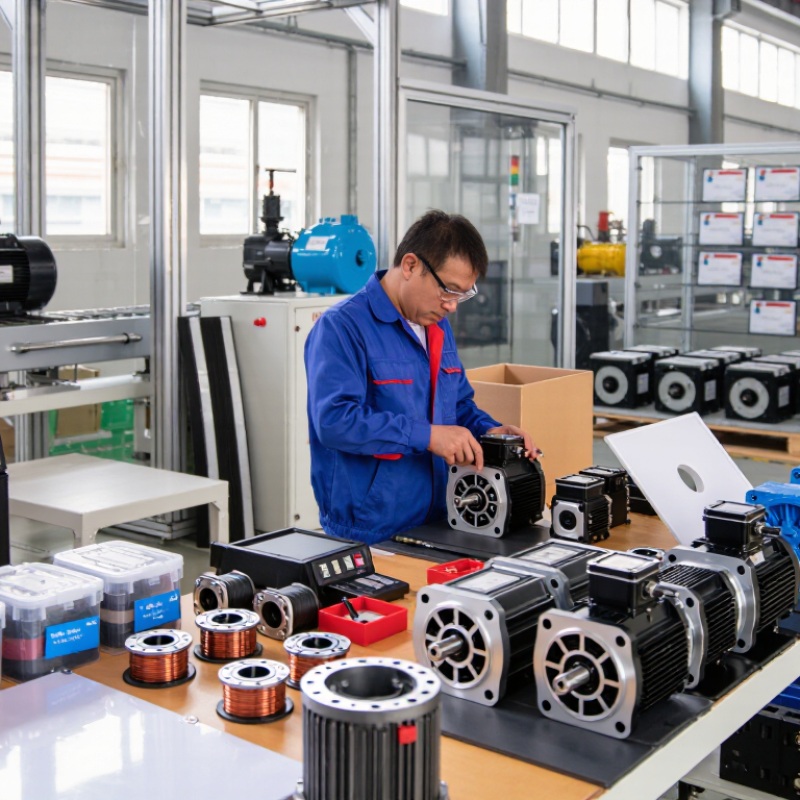
Why Choose a Permanent Magnet Motor for Global Sourcing?

Why Industrial Motors Account for About 45% of Global Electricity Use (IEA)

Why Choose a Permanent Magnet Motor for Global Sourcing?

Industrial motors consume roughly 45% of global electricity, according to widely cited IEA analysis. That figure makes motor selection an energy decision, not only a purchasing decision. In factories, pumps, fans, and conveyors may run for thousands of hours each year. Small efficiency gains can therefore reduce electricity demand and operating costs. Permanent magnet motors create torque without rotor excitation losses. They often deliver strong efficiency at partial loads, where many machines operate most of the day. The saving is practical. It appears on the meter.

Global sourcing requires more than comparing catalog efficiency ratings. Check the motor’s duty cycle, cooling method, speed range, and control compatibility. Ask for tested efficiency data, not only marketing claims. Confirm service access and spare-part availability before placing a large order. A technically excellent motor can still become costly if maintenance support is weak. The calculation is not always clean. Installation quality, load variation, and drive settings can change real results. Engineers should measure existing energy use when possible, then compare it with realistic operating conditions.

Tips: Request independent test records and a clear efficiency map. Review performance at 25%, 50%, and 75% load. Inspect sample units before bulk sourcing. Keep written records of temperature, vibration, noise, and power readings. Ask whether demagnetization protection suits your working environment. Do not select only by purchase price. A lower invoice may hide higher lifetime costs, especially in continuously operated equipment.

How Permanent Magnet Motors Reach IE5 Efficiency Under IEC 60034-30-2

Why Choose a Permanent Magnet Motor for Global Sourcing?

Permanent magnet motors can reach IE5 efficiency under IEC 60034-30-2 when tested under defined operating conditions. Their rotor magnets create magnetic flux without continuous electrical excitation. This reduces rotor copper losses and improves efficiency, especially at partial loads. That matters in pumps, fans, compressors, and conveyor systems that run for thousands of hours each year. Less wasted energy also means lower heat inside the motor.

The inverter is essential. It controls speed and frequency while maintaining efficient torque production. Engineers should check the complete motor-drive system, not the motor label alone. IEC 60034-30-2 efficiency classes apply to specific motor types and test conditions. Rated power, cooling method, load point, and measurement uncertainty all influence the result. A properly documented test report provides stronger evidence than a marketing claim.

Sourcing requires practical inspection. Request efficiency data, temperature-rise results, bearing specifications, insulation details, and compatibility information for the intended drive. Verify performance at common operating speeds, not only at full load. The label alone is not enough. Installation quality can also change real-world efficiency. Incorrect alignment, poor ventilation, or unsuitable cable routing may reduce expected savings. One detail is easy to overlook: rare-earth magnet supply can affect cost and lead time. A careful purchasing team should compare lifecycle value, service support, and replacement access before selecting a permanent magnet motor.

Why Higher Efficiency Can Reduce Motor Lifecycle Costs by Up to 30%

Why Choose a Permanent Magnet Motor for Global Sourcing?

Why Higher Efficiency Can Reduce Motor Lifecycle Costs by Up to 30%

Permanent magnet motors can lower energy use across demanding industrial applications. Their rotor creates magnetic force without additional electrical excitation. This reduces heat and improves efficiency, especially during continuous operation. A pump running thousands of hours can show meaningful savings on every utility bill. In some applications, higher efficiency may reduce total lifecycle costs by up to 30%. The actual result depends on load patterns, electricity prices, controls, and maintenance conditions.

Still, the 30% figure is not guaranteed. A common sourcing mistake is comparing purchase prices alone. Buyers should examine rated efficiency, partial-load performance, duty cycles, cooling requirements, and expected service hours. Verified test data matters more than attractive claims. A suitable motor may also reduce ventilation needs and bearing stress. However, an unsuitable drive or poor installation can erase part of the benefit. That detail is easy to overlook.

Tips: Request efficiency data at several load points. Check compatibility with the planned drive. Estimate five-year energy costs before approving the order. Ask for inspection records and clear warranty terms. Keep the calculations realistic. Forecasts can be wrong.

Why Choose a Permanent Magnet Motor for Global Sourcing? – Why Higher Efficiency Can Reduce Motor Lifecycle Costs by Up to 30%
Comparative lifecycle-cost model for a 15 kW industrial motor. The figures are transparent planning estimates based on common industrial operating conditions; actual results depend on duty cycle, load profile, local electricity prices, installation, and maintenance practices.
Evaluation Dimension Conventional Induction Motor Permanent Magnet Motor Sourcing and Cost Implication
Rated mechanical output 15 kW 15 kW Direct comparison at the same rated output and operating duty.
Typical efficiency at rated load Approximately 90%–93% for an IE3-class motor in this power range Approximately 94%–97%, depending on design and control system Higher efficiency reduces electrical input for the same mechanical output.
Modeled efficiency used 91.0% 95.5% Both values should be verified against the supplier’s test report and applicable IEC efficiency classification.
Annual operating hours 6,000 hours 6,000 hours Long operating schedules increase the financial value of efficiency improvements.
Annual mechanical energy delivered 90,000 kWh 90,000 kWh Calculated as 15 kW × 6,000 hours.
Annual electrical energy consumed 98,901 kWh 94,241 kWh The modeled PM motor saves approximately 4,660 kWh per year.
Annual energy saving Baseline 4,660 kWh versus the induction-motor baseline Equivalent to approximately 4.7% lower electricity consumption in this model.
Electricity price used US$0.15/kWh US$0.15/kWh Replace this assumption with the destination market’s industrial electricity tariff.
Annual electricity cost US$14,835 US$14,136 Estimated annual operating-cost saving: US$699.
Estimated purchase cost US$2,200 US$3,400 PM motors commonly require a higher initial budget because of permanent magnets and dedicated drives.
Estimated 10-year maintenance cost US$1,200 US$600 Potential savings may come from lower rotor losses, reduced heat generation, and less mechanical stress; maintenance remains application-specific.
10-year electricity cost US$148,352 US$141,362 Based on constant operating hours and electricity price, without escalation.
Estimated 10-year lifecycle cost US$151,752 US$145,362 Modeled saving: US$6,390 over 10 years.
Lifecycle-cost reduction Baseline: 0% Approximately 4.2% in the standard operating model Higher reductions require greater operating hours, higher energy prices, lower baseline efficiency, or additional maintenance and downtime savings.
Low-load performance Efficiency may decline significantly at partial load because of magnetizing and rotor losses Generally maintains strong efficiency across a wider speed and load range when correctly controlled Important for pumps, fans, compressors, conveyors, and equipment with variable demand.
Power factor and system demand Power factor can decrease at partial load, increasing apparent power demand Often provides improved power factor when paired with a suitable inverter May help reduce distribution losses and capacity requirements, subject to the complete drive system.
Thermal behavior Higher rotor losses can increase heat generation Lower rotor losses can support cooler operation Potential benefits include longer insulation life and improved suitability for compact installations.
Supply-chain considerations Broad supplier availability and generally simpler replacement sourcing Requires compatibility between motor, permanent-magnet rotor, encoder or sensor package, and drive Request dimensional drawings, control protocols, spare-parts plans, certificates, and end-of-line test data before purchase.
Best-fit application profile Low operating hours, stable full-load operation, and strong price sensitivity High annual utilization, variable-speed operation, energy-intensive duty, or limited cooling capacity PM technology is most financially attractive when energy and downtime costs dominate total ownership cost.
Calculation basis: Annual electricity consumption = annual mechanical energy ÷ efficiency. Ten-year lifecycle cost = purchase cost + ten-year maintenance cost + ten-year electricity cost. The often-quoted “up to 30%” reduction is not universal; it can occur only in favorable applications with high utilization, inefficient or lightly loaded baseline motors, elevated electricity prices, variable-speed operation, and/or substantial maintenance or downtime savings. Obtain certified efficiency data and a site-specific total-cost-of-ownership calculation before final sourcing.

How Rare-Earth Supply Concentration Shapes Global Sourcing Risk (IEA)

Why Choose a Permanent Magnet Motor for Global Sourcing?

Permanent magnet motors offer high efficiency, compact size, and strong performance at variable speeds. These benefits matter when equipment must operate reliably across different markets. Yet their magnets can create a less visible sourcing risk.

The International Energy Agency has repeatedly highlighted the concentration of rare-earth mining, refining, and magnet production. A disruption at one processing stage can affect suppliers worldwide. Neodymium and praseodymium support powerful magnets, while dysprosium or terbium may improve high-temperature performance. Their availability, processing capacity, and prices are not evenly distributed.

Procurement teams should examine more than a supplier’s factory location. Ask where the raw materials are refined, how many upstream processors are involved, and whether material documentation is current. A second supplier may still depend on the same refiner. That is easy to miss.

Practical sourcing plans can include approved alternative magnet grades, verified recycled content, controlled safety stock, and regular supplier audits. Engineers should test these options before a shortage occurs. Small design changes may reduce exposure, but they can also affect efficiency or temperature limits. Trade-offs remain real. A permanent magnet motor may still be the right choice, but its supply chain deserves the same engineering attention as its electrical design.

Which Technical and Compliance Data Should Guide Global Motor Selection

Why Choose a Permanent Magnet Motor for Global Sourcing?

Global motor selection should begin with verified technical data, not attractive efficiency claims. A permanent magnet motor should be assessed by rated power, voltage, current, speed range, torque curve, and duty cycle. Check starting torque carefully. Some applications need stable torque at low speed. Others require frequent acceleration, braking, or variable-speed control. Efficiency should be reviewed across the real operating range, not only at one laboratory point.

Thermal class, insulation system, cooling method, bearing life, noise level, and ingress protection also matter. Ask for test conditions, measurement tolerances, and the latest test reports. Compliance data needs equal attention. Confirm applicable electrical safety, electromagnetic compatibility, energy-efficiency, material, and environmental requirements in each target market. Certificates must match the exact motor model and configuration. A document with a similar product name may create serious sourcing risk. In practice, sample testing under load often reveals temperature rise or vibration issues hidden by a clean datasheet.

Tips: Request a complete data sheet, declaration, test report, and traceable serial information. Compare declared efficiency with measured results. Review factory quality controls and calibration records. Do not assume one approval covers every destination. That assumption is easy to make, and sometimes costly. A small pilot order can expose connector, controller, or installation problems before wider purchasing.

FAQS

Why are industrial motors important for global energy use?

Industrial motors consume roughly 45% of global electricity. They power pumps, fans, conveyors, and factory equipment. Small efficiency gains can reduce yearly electricity demand.

How can a permanent magnet motor reduce energy use?

Its rotor creates magnetic force without electrical excitation. This reduces rotor losses and heat. Savings become visible on the meter.

When does higher efficiency provide the greatest benefit?

Continuous-duty equipment usually gains the most. A pump running thousands of hours can save energy every month. Partial-load performance also matters.

Can higher efficiency reduce lifecycle costs by 30%?

It may reduce total lifecycle costs by up to 30% in suitable applications. The result depends on load patterns, electricity prices, controls, and maintenance. Thirty percent is not guaranteed.

What should buyers check before global sourcing?

Review duty cycle, cooling method, speed range, and drive compatibility. Request tested efficiency data at 25%, 50%, and 75% load. Catalog ratings alone can mislead.

Why should installation quality be included in cost calculations?

Poor installation or incorrect drive settings can erase efficiency gains. Load variation also changes real energy results. The spreadsheet may look better than reality.

What supply-chain risks can permanent magnet motors create?

Magnet materials may rely on concentrated mining, refining, and production networks. A disruption at one stage can affect suppliers worldwide. Factory location is not enough.

How can buyers reduce magnet supply risks?

Ask about refining sources, upstream processors, and current material records. Consider approved alternative magnet grades and reasonable safety stock. Test substitutes early. Trade-offs remain.

Conclusion

Industrial motors consume a significant share of global electricity, making motor efficiency a key priority for manufacturers, facility operators, and international sourcing teams. A Permanent Magnet Motor can achieve IE5-level efficiency under IEC 60034-30-2 by reducing electrical losses and maintaining strong performance across varying loads. This improved efficiency may lower energy consumption, maintenance needs, and total lifecycle costs by up to 30%, especially in applications that operate continuously or at partial load.

However, global sourcing requires more than comparing rated efficiency. Rare-earth material supply is concentrated in a limited number of regions, creating potential risks related to availability, pricing, logistics, and supply continuity. Buyers should therefore evaluate motor efficiency data, operating curves, power factor, thermal performance, service requirements, certifications, environmental compliance, documentation quality, and supplier traceability. A balanced assessment of technical performance, regulatory conformity, long-term cost, and supply-chain resilience can support reliable motor selection for international projects.

Amelia

Amelia

Amelia is a seasoned marketing professional with a wealth of expertise in our company’s core offerings. With an unwavering passion for driving growth and innovation, she plays a pivotal role in shaping our marketing strategies and enhancing brand visibility. A key aspect of her responsibilities......